statswork

Stronger Analysis. Smarter Research. Bigger Savings!
Access expert statistical analysis and research support at Flat 24% Off
Stronger Analysis. Smarter Research. Bigger Savings!
Access expert statistical analysis and research support at Flat 24% Off.

Collecting Your Own Data-Primary Research

Good decisions should be based on reliable and relevant evidence. Primary research can be particularly useful when existing secondary evidence cannot adequately answer a specific business question or does not provide sufficiently current, relevant, or specific insights. By collecting information directly from the market, organizations can obtain evidence tailored to their research objectives and decision context.

What Is Primary Research, and Why Does It Matter for B2B Teams?

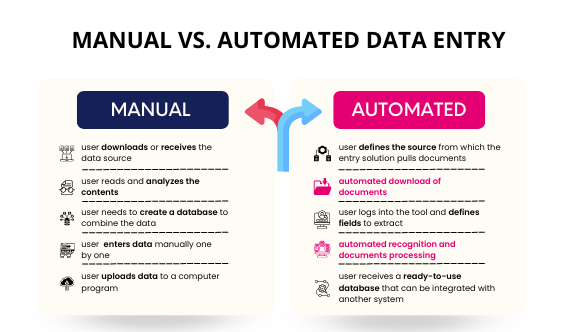
What we call primary research is collecting firsthand information through surveys, interviews, observations, and experiments — as compared to secondary research, where the information has already been collected by someone else and published.
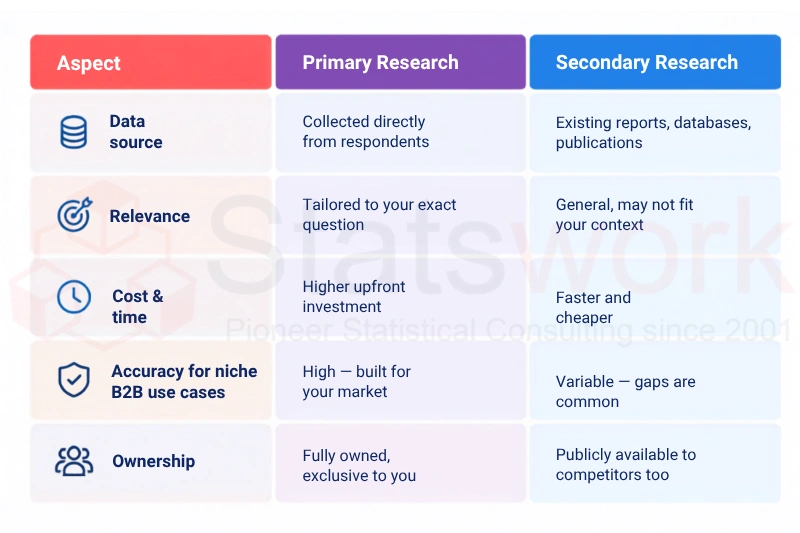
v1- Collecting Your Own Data-Primary Research - Recreation image (2)

When exploring a market, testing an idea, or assessing competitors, primary data collection may be appropriate when credible secondary data is unavailable or does not adequately address the evidence needed for the decision. The choice should consider the research question, evidence gaps, decision context, available time and budget, and the quality and relevance of existing secondary data.[2].

Core Primary Research Methods Used in Corporate Settings

Different business questions call for different data collection techniques. Below is a quick comparison corporate researchers commonly rely on:

Method Suitable for Advantages Drawing backs
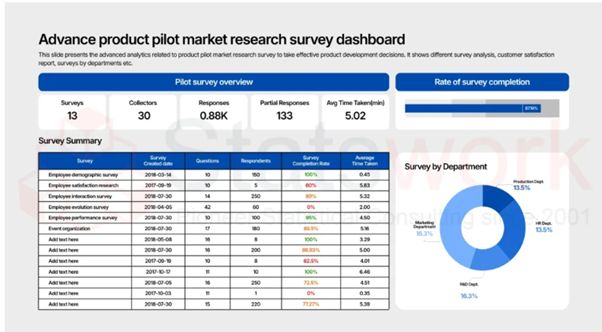
Surveys
& Questionnaires
Market demand, customer satisfaction and price sensitivity surveys • Easy to quantify and analyse at scale.[1] Lacks depth, wording bias possible in badly constructed surveys
Interviews (Structured/Semi-structured) Exploring buyer motivations and executive decision drivers Profound insights, additional questions can be posed Time-consuming, difficult to scale up, interviewer bias possible
Focus Groups Market testing of new products, messages and branding Captures group dynamics Prone to groupthink, not statistically representative
Observation Behavior in actual work environment, usage patterns, market
environments
• Captures observed behaviour rather than relying solely on
self-report, while recognising potential observational bias and contextual
effects.
Resource intensive; small samples
Experiment / A-B Test Pricing models, product features and marketing creative [3] • Causal relationships can be supported when the research is
appropriately designed and controlled.
Need to create controlled environments, expensive

A Practical Workflow for Collecting Primary Data

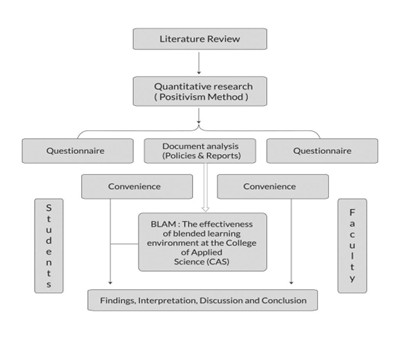
A reliable primary research project generally follows this sequence:

  • Define the research objective – What is the decision that needs to be made in business?
  • Define the target audience – Business to Business decision makers, buyers, end users or industry segment.
  • Choose the methodology – The methodology is determined based on the objective and budget.
  • Prepare the tool – Questionnaire, interview guide or experimental design is developed and tested for its effectiveness.
  • Data Collection – Conducting field work through the chosen medium – online panel, phone interviews, face-to-face interviews or using digital tools.
  • Cleaning and validating the responses – Identify duplicate responses, assess missing or inconsistent data, apply predefined quality-control rules, document any exclusions, and prepare the validated dataset for analysis.
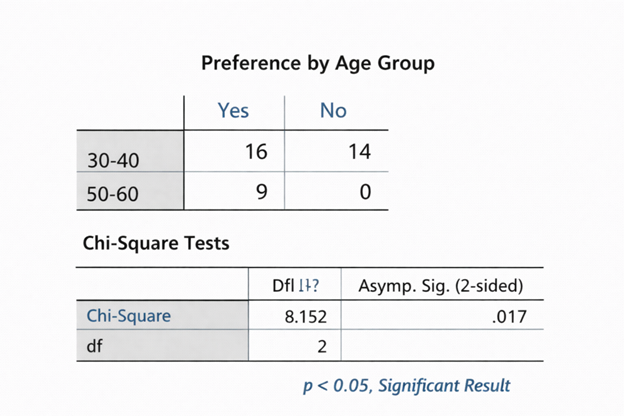
  • Analysis and Reporting – Applying the relevant statistical tool and developing a business-ready report [2].

Primary Research for Competitive Analysis and Business Decisions

For competitor analysis, B2B teams can use industry-expert interviews, mystery shopping, and structured surveys among existing or target customers to understand competitor positioning, customer preferences, and market gaps.

When primary research is needed for decision-making, such as market entry, product introduction, or M&A, mixed methods may be useful when both quantitative estimation and qualitative explanation are required. Quantitative surveys can help estimate the scope of an opportunity, while qualitative interviews can provide deeper insights into the reasons, motivations, and experiences behind the findings.

Why Corporate Teams Outsource Primary Data Collection

Internal execution of primary research requires a respondent panel, trained interviewers, surveys tools license, and statistical analysis skills, which is not something that many corporate organizations maintain all-year round. This is why more organizations choose to outsource their primary data collection needs to professional companies specializing in such services [2].

The primary research company specializes in providing:

  • Support for identifying and reaching relevant B2B and individual respondents based on research requirements.
  • Questionnaire and interviews designs validated by professionals
  • Capacity to support fieldwork across multiple countries and languages, including through qualified research partners where required.
  • Built-in statistics and report generation
  • A faster turn around than establishing an internal research capability

At Statswork we offer comprehensive primary market research solutions throughout the whole research process from the problem statement development to fieldwork, data processing, and statistical analysis for decision makers.

Final Thoughts

Primary research can provide current, question-specific evidence when existing sources are insufficient. Whatever methodology you adopt – be it a survey, interview, observation, or experiment – it should always come after identifying the question that needs to be answered, not before. For organizations that require a quick turnaround and rigorous statistical methods without creating a dedicated research unit, working with a corporate market research services company can be an efficient way to move from research questions to actionable answers.Ready to collect data that actually answers your business question? Talk to Statswork’s research experts today.

Frequently Asked Questions (FAQs)

Primary data can be collected directly from respondents through surveys, questionnaires, interviews, focus groups, observations, and experiments, depending on the research objective and target audience.

The seven steps to collecting research data are defining the research objective, identifying the target audience, selecting the data collection method, developing and testing the research tool, collecting the data, cleaning and validating the responses, and analyzing and reporting the findings.

Research data can be collected through online surveys, telephone or face-to-face interviews, focus groups, observations, experiments, and other digital data collection methods based on the research question.

Examples of primary research data include survey responses, interview responses, focus group feedback, observed customer behavior, experimental results, product testing feedback, and data collected directly from research participants.

Ten examples of primary sources include surveys, questionnaires, interviews, focus group discussions, observation records, experimental results, field notes, direct customer feedback, original research datasets, and laboratory or clinical measurements.

Seven basic research methods include surveys for measuring customer satisfaction, interviews for understanding buyer motivations, focus groups for testing products or messages, observations for studying user behavior, experiments for testing pricing or product features, case studies for examining specific business situations, and field studies for collecting data in real-world settings.

References

  1. Vassilikopoulou, A., & Fotiadis, T. (2026). Business-to-Business (B2B) Market Research. The Sage Handbook of Industrial Marketing, 181.https://books.google.co.in/books?
  2. Lim, W. M., Sethuraman, R., Kathuria, S., & Manrai, A. K. (2025). Guidelines for data collection and analysis: Considerations for informed marketing in a globalized world. Journal of Global Marketing38(2), 103-112.https://www.tandfonline.com/doi
  3. Jaiswal, K., & Kulkarni, S. (2025). Role of Primary and Secondary Research in a B2B Lead Generation: A Practical Approach. AIJFR-Advanced International Journal for Research6(6).https://www.aijfr.com

Contact us