


What are the importance’s of data collection in different areas? Mention some tools used in data collection.
December 17, 2020
What are the disadvantages of meta-analysis in observational statistical studies?
December 24, 2020How Can Questionnaires Differ Based on Distribution, and What Are the Advantages of Using a Questionnaire in Market Research?
Meta Analysis Service
- What is a Questionnaire?
- Survey vs Questionnaire: What's the Difference?
- Types of Questionnaires
- Common Question Formats: Questionnaire Examples
- Questionnaire Design and Distribution
- Advantages and Disadvantages of Questionnaire
- Questionnaires in Market Research
- Ensuring Questionnaire Validity and Reliability
- Conclusion
Recommended Reads
Contact us
Summary:
Questionnaires refer to data gathering tools that help collect both qualitative and quantitative data using different modes of distribution. The main difference between questionnaires and surveys is that questionnaires are the actual tools for collecting data while surveys are the whole research processes. Questionnaires can be of great use for business organizations since they provide accurate and cost-effective ways of collecting customer data and analyzing market trends. However, their effectiveness is limited by factors such as biases and low participation rates.
Questionnaire is an efficient tool for collecting information using a set of questions that are put together to form a question-based data collection tool that can be distributed in different formats such as online, through a written form, telephone, and in-person surveys [1]. This guide offers definitions and clarifications of what is a questionnaire, how it is different from a survey, types of distributions, and reasons why a questionnaire is highly valued in market research.
What is a Questionnaire?
Questionnaire refers to an information gathering tool that consists of a structured set of questions that are used to collect both qualitative and quantitative data. Open questions, closed questions, or a combination of the two can be used, but it is usually administered to a particular sample size of people [2].
Survey vs Questionnaire: What's the Difference?
The terms are often used interchangeably, but there is a technical distinction between survey vs questionnaire usage.
| Aspect | Questionnaire | Survey |
| Definition | Collection of questions in writing, which acts as a tool for collecting data | Broad research process in which a questionnaire can be one of the tools |
| Scope | Single tool or form | Wide processes encompass designing, administering, analyzing and other processes |
| Objective | Data collection | Conclusions from the data collected |
| Illustration | Form for collecting customer satisfaction | Customer satisfaction survey using that form |
In short, a questionnaire vs survey comparison shows that the questionnaire is the tool, while the survey is the overall research exercise built around it [3].
Types of Questionnaires
The questionnaires can be broadly divided into the following three types:
- Structured Questionnaire – It is the questionnaire that has closed-ended questions with predefined choices in response.
- Unstructured Questionnaire – It includes open-ended questions where respondents can respond freely.
- Semi-Structured Questionnaire – In this type of questionnaire, both closed-ended and open-ended questions are used together [4].
Common Question Formats: Questionnaire Examples
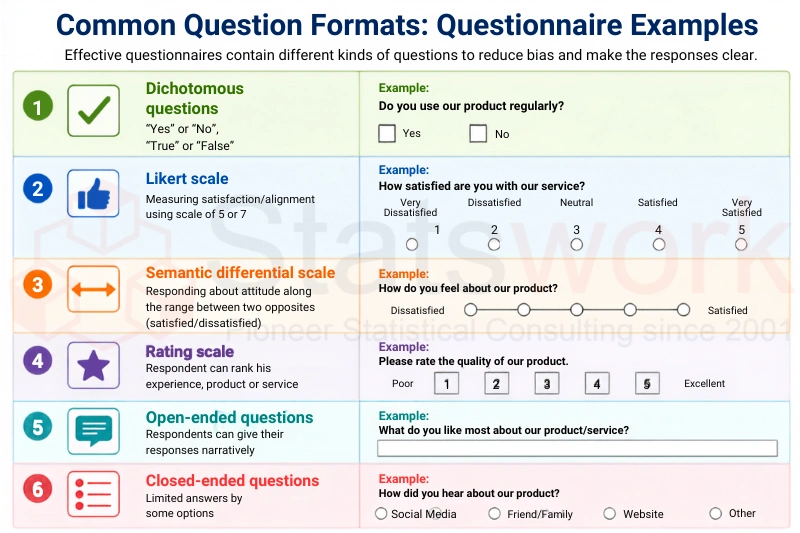
Effective questionnaires contain different kinds of questions to reduce bias and make the responses clear:
- Dichotomous questions – “Yes” or “No”, “True” or “False”
- Likert scale – Measuring satisfaction/agreement using scale of 5 or 7
- Semantic differential scale – Responding about attitude along the range between two opposites (satisfied/dissatisfied)
- Rating scale – Respondent can rank his experience, product or service
- Open-ended questions – Respondents can give their responses narratively
- Closed-ended questions – Limited answers by some options [3]
Questionnaire Design and Distribution
Good questionnaire design begins with the development of objectives and proper sequencing of the questions. Contemporary software makes it possible to employ logic and branching questions that enable the respondents to be taken to subsequent related questions depending on the previous answer provided [2].
There are several distribution methods that greatly affect the performance of the questionnaire:
- Internet questionnaire – delivered using e-mail or link; inexpensive, quick, and easy to analyze but can suffer from selection bias because of a biased sample of internet users
- Phone-based – enables real-time questioning but is relatively slow
- Paper based – good for areas that have poor connectivity but takes a long time to process
- Digital distribution of the questionnaire through respondent panels – enables quick delivery and analysis of the data
Selecting the proper distribution medium determines the response rate, cost, and speed of delivery.
Advantages and Disadvantages of Questionnaire
Benefits:
- Cheap method of data collection among many respondents
- Easy to standardize, thereby making data analysis quick and simple
- The internet can be used to distribute the questionnaire in no time
- Anonymous nature helps reduce respondent bias on sensitive issues
Drawbacks:
- May suffer from low response rate
- Limited insights when compared with interviews because of closed-ended nature
- May cause respondent and selection bias due to poor wording of questions
- Large questionnaires may cause fatigue among respondents [2]
Questionnaires in Market Research
The market research questionnaire is the most common data collection tool in gathering information on customer preferences and market trends. The specific purposes of questionnaires include:
- Customer satisfaction questionnaire – this measures the satisfaction level of the customer with respect to the offered products/services.
- CSAT questionnaire – measures the satisfaction levels immediately after a transaction or encounter with a product/service.
- NPS survey – measures the level of loyalty of customers towards the brand.
Ensuring Questionnaire Validity and Reliability
Before the widespread application of the questionnaire, the piloting stage allows us to verify its validity and reliability. With careful choice of questions, sample size, and method of distributing the questionnaire, the bias can be avoided and the quality of the collected information improved [3].
Conclusion
Questionnaires still happen to be one of the most flexible and inexpensive ways of collecting data in market research studies [4]. The selection of the right mode of distribution and the right type of questions used determines the effectiveness of the study itself. Companies looking to create highly effective questionnaires can utilize the market research services offered by Statswork.
Frequently asked question:
Questionnaires are widely used in market research because they provide a cost-effective and efficient way to collect data from a large audience. They help businesses understand customer preferences, buying behavior, satisfaction levels, and market trends while producing standardized data that is easy to analyze and compare.
Questionnaires offer several advantages, including low-cost data collection, standardized responses, broad participant reach, and ease of statistical analysis. However, they also have limitations such as low response rates, limited opportunities for clarification, the risk of inaccurate or biased responses, and difficulties in capturing detailed qualitative insights.
A questionnaire is a research instrument consisting of a set of questions used to gather information from respondents, whereas a survey is the overall research process that includes designing the questionnaire, collecting responses, analyzing data, and interpreting the findings. In other words, a questionnaire is one component of a survey.
The main types of questionnaires include structured questionnaires with predefined questions, unstructured questionnaires with open-ended questions, open-ended questionnaires that allow detailed responses, closed-ended questionnaires with fixed answer choices, and mixed questionnaires that combine both open-ended and closed-ended questions.
The four common types of surveys are online surveys, telephone surveys, face-to-face surveys, and mail surveys. Each method has its own advantages depending on the research objectives, target audience, budget, and required response quality.
Questionnaire surveys may suffer from low response rates, respondent bias, incomplete or inaccurate answers, and the inability to probe deeper into participants’ responses. They may also exclude individuals with limited access to digital platforms or those who have difficulty understanding the questions.
Reference:
- Marshall, G. (2005). The purpose, design and administration of a questionnaire for data collection. Radiography, 11(2), 131-136.
- Lietz, P. (2010). Research into questionnaire design: A summary of the literature. International journal of market research, 52(2), 249-272. https://journals.sagepub.com/doi/abs/10.2501/S147078530920120X?__cf_chl_f_tk=dPOBSxzppao3yVlWA5IBu3dw2WGQjpJYL0rywixPrpg-1783071561-1.0.1.1-EmHRRbNLHiUMJF.HcM.hRvIl7dwN6oNs0THheUhQOa0
- Dalati, S., & Marx Gómez, J. (2018). Surveys and questionnaires. In Modernizing the academic teaching and research environment: Methodologies and cases in business research(pp. 175-186). Cham: Springer International Publishing. https://link.springer.com/chapter/10.1007/978-3-319-74173-4_10
- Baker, M. J. (2003). Data collection–questionnaire design. The marketing review, 3(3), 343-370. https://www.ingentaconnect.com/content/westburn/tmr/2003/00000003/00000003/art00007?__cf_chl_f_tk=fBLgZiuWMRY_Ydut91JqohqlmuG6FuuJDzDK9m3SHIg-1783071589-1.0.1.1-3RQjNZ9vIqE9txyeeuGfKvEfaP4UlTXqBe1VOllU6Lc
Contact us

Related posts


