
- Services
- Data Analysis services
- Sample Work
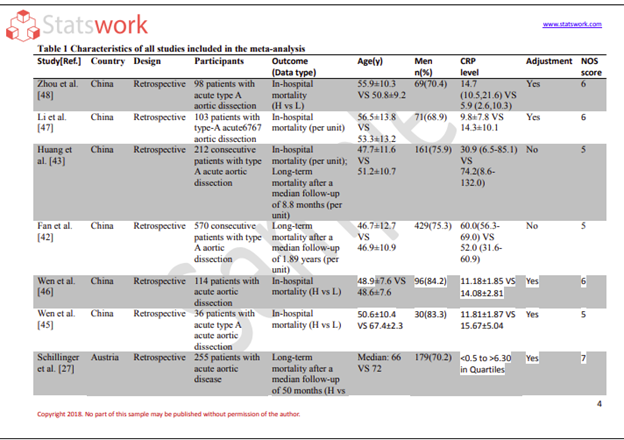
Data Analysis services
- Secondary Qualitative Research Services
- Secondary Quantitative Research Services
- Meta-Analysis Research services
- Sample Work
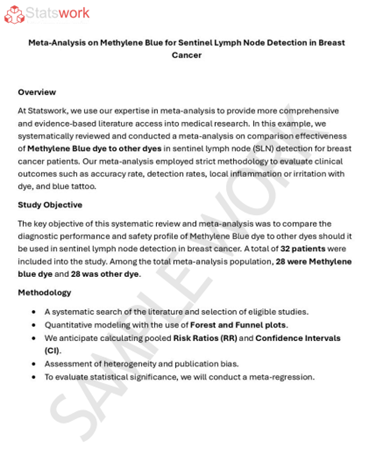
Meta-Analysis Research Services
- Data Collection Services
- Sample Work
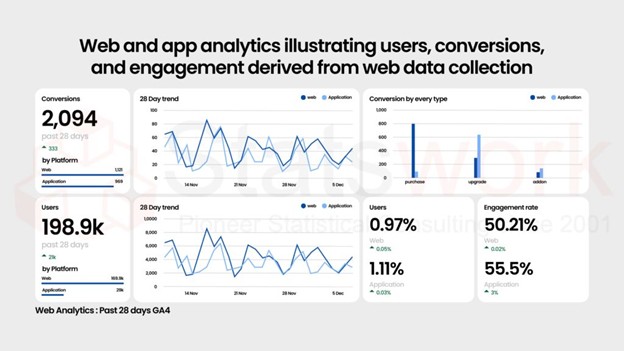
Data Collection Services
- Statistical & Biostatistics services
- Sample Work
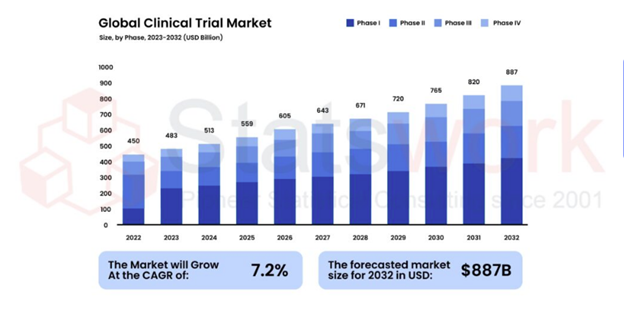
Statistical Programming & Biostatistics services
- Data Management Services
- Sample Work
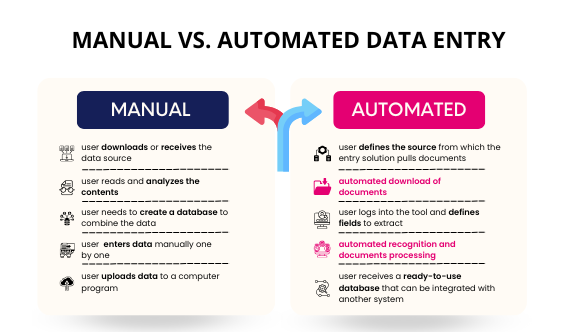
Data Management Services
- Research methodology services
- Sample Work
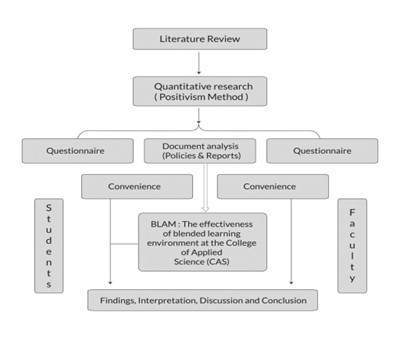
Research methodology services
- Tool Development Services
- Sample Work
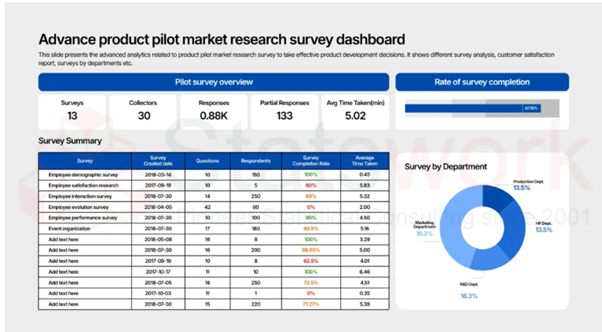
Tool development services
- Statistical Interpretation services
-
Statistical Interpretation services
- Sample Work
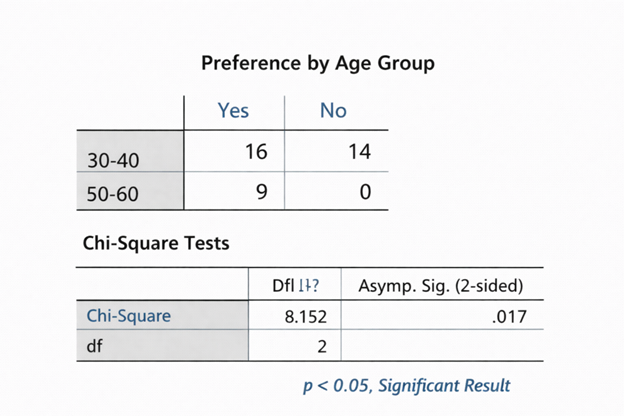
Statistical Interpretation services
-
- Sample Size Calculation Services
-
Sample Size Calculation Services
- Sample Work
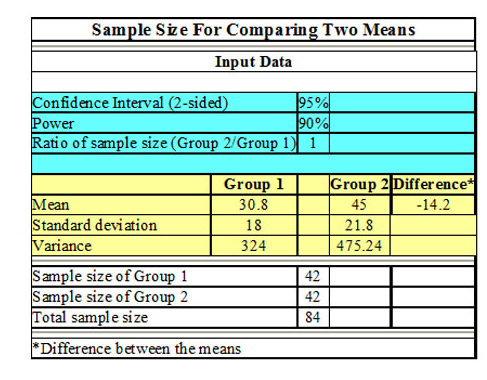
Sample Size Calculation Services
-
- AI & ML Services
-
Artificial Intelligence and Machine Learning Services
- Sample Work
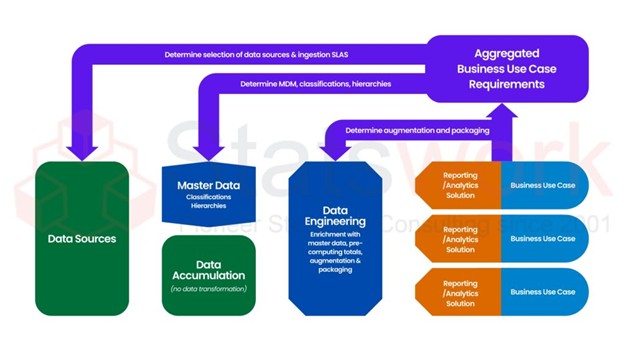
Artificial Intelligence and Machine Learning Services
-
- Meaningful Visualization Services
- Thought Leadership Services
- Report Generation Services
-
Report generation Service
- Sample Work
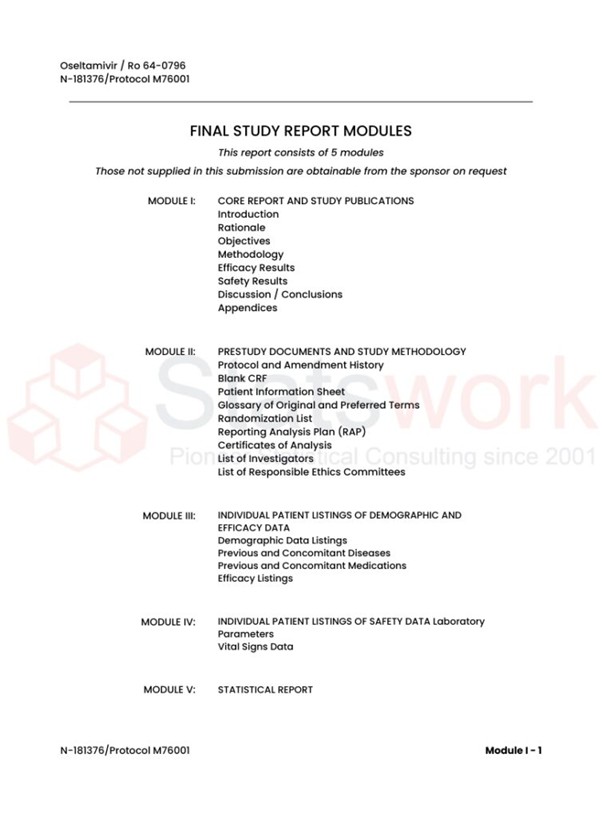
Report generation Services
-
- Data Analysis services
- Industries
- About Us
- Blog
- Insights
- Contact Us
- Services
- Data Analysis services
- Sample Work
Data Analysis services
- Secondary Qualitative Research Services
- Secondary Quantitative Research Services
- Meta-Analysis Research services
- Sample Work
Meta-Analysis Research Services
- Data Collection Services
- Sample Work
Data Collection Services
- Statistical & Biostatistics services
- Sample Work
Statistical Programming & Biostatistics services
- Data Management Services
- Sample Work
Data Management Services
- Research methodology services
- Sample Work
Research methodology services
- Tool Development Services
- Sample Work
Tool development services
- Statistical Interpretation services
-
Statistical Interpretation services
- Sample Work
Statistical Interpretation services
-
- Sample Size Calculation Services
-
Sample Size Calculation Services
- Sample Work
Sample Size Calculation Services
-
- AI & ML Services
-
Artificial Intelligence and Machine Learning Services
- Sample Work
Artificial Intelligence and Machine Learning Services
-
- Meaningful Visualization Services
- Thought Leadership Services
- Report Generation Services
-
Report generation Service
- Sample Work
Report generation Services
-
- Data Analysis services
- Industries
- About Us
- Blog
- Insights
- Contact Us
How Data Collection Tools Are Transforming Business Analysis: Top Software Used in Corporate Research
Meta Analysis Service
Recommended Reads
Contact us
Summary:
Data-driven decision-making depends on data collection tools and the quality of the information collected depends on these tools. This guide will provide an explanation about the reasons for which data collection tools have become an important part of business research and will reveal the differences between suitable and unsuitable data collection platforms. Some of the most popular platforms used by businesses today include Forms On Fire, GoSpotCheck, Teamscope, Open Data Kit, KoboToolbox, Magpi, Repsly, and SurveyCTO.
Introduction
A data collection tool is more than a digital replacement for a paper form. In business research, the selected tool can influence how consistently variables are captured, how validation rules are applied, how missing or inconsistent responses are identified, and how efficiently the resulting dataset can be prepared for analysis. The appropriate choice therefore depends on the research design, type of data, collection environment and downstream analytical requirements [1].
This guide will explain why you need such tools in your business research and introduce you to some reliable data collection platforms.
Why Data Collection Tools Matter in Business Research
A data collection tool can either be a software application or an instrument used to collect data. The application of data collection tools in business research goes far beyond their use in inputting information. They make it possible for the team to do the following:
- Collection of data from multiple locations, devices, and people
- Limiting chances of errors in data collection because of human mistakes
- Support data collection from primary sources like surveys and interviews as well as secondary sources of data
- Work offline and upload when internet connection is restored [2]
- Visualise collected data instantly
- Be integrated with existing applications including CRM and Excel files
Platform selection becomes particularly important for teams who hire external data collection service providers [2].
Best Data Collection Software Used in Business Research
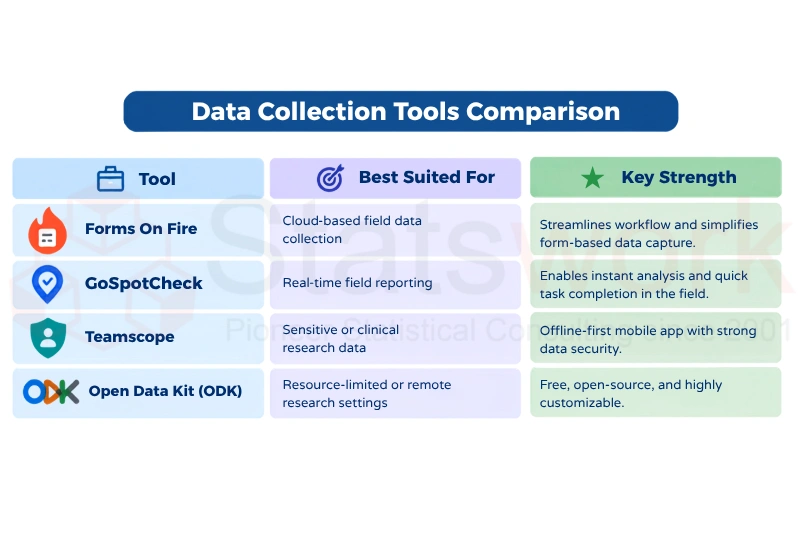
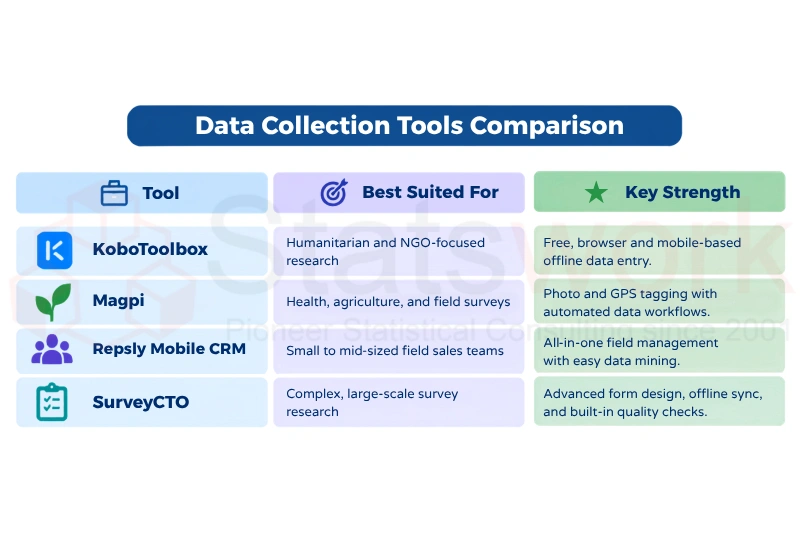
The table below compares some of the most widely used data collection platforms in corporate and field research, along with what each one is best suited for.
| Data Collection Tool | Best Suited For | Key Capability | Consideration |
|---|---|---|---|
| KoboToolbox | Field and survey research | Mobile/offline data collection | Useful where internet connectivity is limited |
| ODK | Structured field data collection | Mobile forms and offline collection | Requires appropriate form and deployment setup |
| SurveyCTO | Research and field surveys | Data collection, validation and secure workflows | Suitable for structured research projects |
| Teamscope | Clinical and field research | Mobile data collection and data management | Particularly relevant to structured field studies |
| GoSpotCheck | Operational field research | Mobile workflows and field observations | Useful for distributed teams |
| Forms On Fire | Business and field data capture | Digital forms and workflow automation | Suitability depends on integration requirements |
| Magpi | Mobile data collection | Mobile forms and field data capture | Appropriate use depends on project requirements |
| Repsly | Field operations | Mobile workforce and field data capture | More operational than academic research-focused |
How to Choose the Right Data Collection Platform
However, not all tools will be appropriate for all corporate needs. In determining whether to adopt a certain enterprise data collection software [1], companies will have to consider the following:
- Type of data: Does the software support both qualitative and quantitative data tools?
- Connectivity: Will the software work even without connectivity for field data collection tools in hard-to-reach places?
- Security: Is the data collection tool compliant with the industry’s confidentiality rules?
- Scalability: Can the software cope with future increases in survey and data management software needs?
- Integration: Does the data collection software integrate with other analytics or CRM systems?
Conclusion
The right data collection tool can improve the consistency, efficiency and traceability of business research, but software selection should be driven by the research requirements rather than popularity alone. Businesses should evaluate data type, validation needs, connectivity, security, scalability and integration before selecting a platform. Where collection involves complex research designs, multiple sources or substantial data-quality requirements, professional support can help ensure that the resulting dataset is structured and suitable for analysis.
Need support with your business data collection process? Talk to a Statswork data collection expert.
Selecting the wrong tool can cost your team time, money, and data accuracy. Talk to a Statswork data collection expert today and get expert guidance on outsourcing your data collection services, so your business research stays accurate, efficient, and decision-ready from day one.
Frequently Asked Questions (FAQs)
Depending on the platform, collected data may be exported or integrated with spreadsheets, databases, statistical software, business intelligence platforms, CRM systems, or other analytical environments. The appropriate integration depends on the research workflow and data format.
Business analysts commonly use Excel, Power BI, Tableau, SQL, and Python to analyze data, identify trends, and create business reports and dashboards.
Common data collection tools include questionnaires, surveys, interviews, observation forms, focus groups, experiments, and secondary data sources.
The top five widely used tools are Excel, SPSS, R, Python, and SAS.
Businesses should consider the type of data being collected, survey or form requirements, offline capability, validation features, data security, scalability, integration with existing systems, and how easily the collected data can be prepared for analysis.
Ten widely used research tools are Google Scholar, PubMed, Scopus, Web of Science, Zotero, Mendeley, SPSS, R, Python, and Qualtrics.
References:
- Diachenko, D., Korobeinikov, M., Korobeinikov, O., Kovalenko, A., & Kravchenko, P. (2025). Data processing methods in a corporate network. Системи управління, навігації та зв’язку. https://journals.nupp.edu.ua/sunz/en
- Dahiya, R., Kaple, G., Anute, N., Sudheer, P., Selvakumar, P., Manjunath, T. C., & Sharma, M. (2026). AI Tools for Automating Data Collection and Analysis. In Revolutionizing Academic Research With AI and Augmented Reality (pp. 459-486). IGI Global Scientific Publishing.https://www.igi-global.com/chapter/ai-tools-for-automating-data-collection-and-analysis/386566