

Multilevel Model Comparison and Statistical Diagnostics for Reliable Meta-Analysis Research
November 2, 2019
Multiplicity Problem in Clinical Trials and Some Statistical Approaches
November 19, 2019Qualitative Research methodology in healthcare/hospitals
Meta Analysis Service
Recommended Reads
Contact us
Summary:
In healthcare, qualitative research aids researchers in understanding the experience of patients, point of view of healthcare professionals, and practices of the healthcare sector. With qualitative research methodologies such as interviews, focus groups, observations, and case studies, one can gain significant insights which will aid in providing patient-centric healthcare solutions. Although there are many difficulties associated with data collection and interpretation in qualitative research, it still forms a crucial aspect of healthcare research.
Introduction
Research in the field of healthcare is more than just numbers, statistics, and tangible results. In addition to this, it is also necessary to learn more about the experiences of patients and the viewpoints of healthcare practitioners, as well as social factors involved in healthcare provision. It is at this point that qualitative research comes in handy. Unlike quantitative research, qualitative research is aimed at studying human experiences, behaviors, emotions, perceptions, and interactions [1].
By engaging in qualitative research in hospitals and healthcare organizations, researchers may find out more about various issues related to patient care and experience, as well as healthcare organization policy.
What is Qualitative Research in Healthcare?
Qualitative research is a systematic method of studying human experiences and societal phenomena using non-numeric data. It concentrates on gaining insight into the beliefs, attitudes, feelings, motivations, and actions of individuals in a certain situation [2].
In terms of the health care field and hospitals, qualitative research aims at answering such questions as follows:
- How does the patient experience a particular disease or treatment?
- What issues do health care professionals encounter while performing their routine tasks?
- What is the perception of the quality of hospital services among patients?
- What factors affect healthcare decision-making?
The gathered information will involve conducting interviews, holding focus groups, performing observation, doing case study, analyzing documents, etc. Afterward, the obtained information is analyzed to reveal patterns, themes, and other important elements to improve healthcare.
Importance of Qualitative Research in Healthcare
Qualitative research has become vital for healthcare research because it ensures that there is a link between clinical research and the lived experiences of patients. Quantitative research can reveal whether a medical procedure works, but qualitative research explains what the experiences of the patient are and how the delivery of health care could be improved [3].
Among the advantages of qualitative research in health care are:
Understanding Patient Experiences
The way a patient experiences an illness is unique to their individual characteristics, including their social and cultural backgrounds. Qualitative research enables health care practitioners to appreciate the uniqueness of the patient’s condition and offers appropriate care.
Supporting Patient-Centered Approach
Contemporary medicine promotes a patient-centered approach to health care. Qualitative research helps discover the needs and expectations of the patient through interviews and observations, thereby helping create patient-friendly health care services.
Discovering Healthcare Service Gaps
Through qualitative research, it becomes possible to reveal such gaps that statistics would never be disclosed. This includes discovering communication barriers, patient dissatisfaction, healthcare inequalities, and other similar problems [4].
Informing Healthcare Policymaking
Policymakers can use the insights from qualitative research to develop healthcare programs and education initiatives aimed at addressing patients’ problems.
Common Qualitative Research Methods Used in Hospitals
| Techniques | Description |
|---|---|
| In-depth interviews | Interviews involving individuals to learn about their experiences related to healthcare. |
| Focus group discussions | Group discussions used to explore people’s experience and views regarding certain aspects of healthcare. |
| Observation | Observation in healthcare organizations and procedures. |
| Case studies | Detailed studies of patients, departments, or healthcare initiatives. |
| Analysis of documents | Evaluation of records, reports, or other materials regarding healthcare initiatives. |
Popular Qualitative Research Designs in Healthcare
Selecting the appropriate research design is essential for generating meaningful results.
- Phenomenology: This type of research studies the actual experiences of patients or practitioners, and their interpretation of events occurring within the domain of health care.
- Grounded Theory: This involves creating theories using data obtained to study processes in the context of health care [5].
- Ethnography: This type of research is concerned with the study of culture and human behavior by observing them in a natural setting of health care.
- Qualitative Case Study: This involves an intensive analysis of issues and/or organizations or institutions in the health care sector.
Challenges of Conducting Qualitative Research in Healthcare
Although qualitative research offers valuable insights, researchers often encounter several challenges.
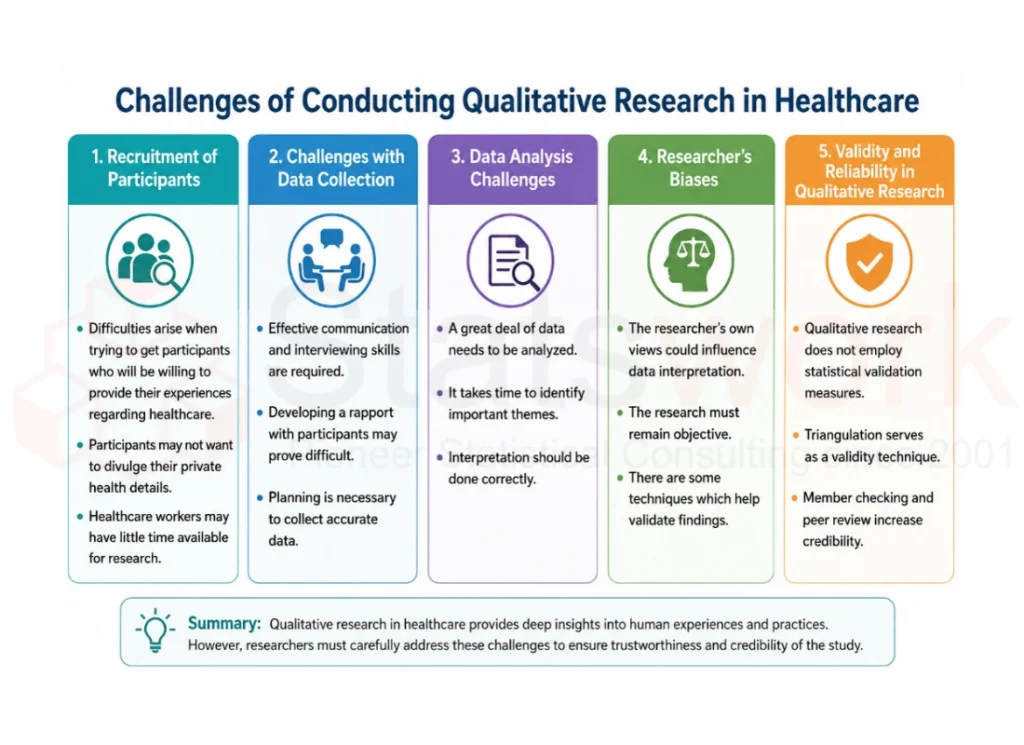
Recruitment of Participants
- Difficulties arise when trying to get participants who will be willing to provide their experiences regarding healthcare.
- Participants may not want to divulge their private health details.
- Healthcare workers may have little time available for research.
Challenges with Data Collection
- Effective communication and interviewing skills are required.
- Developing a rapport with participants may prove difficult.
- Planning is necessary to collect accurate data.
Data Analysis Challenges
- A great deal of data needs to be analyzed.
- It takes time to identify important themes.
- Interpretation should be done correctly.
Researcher’s Biases
- The researcher’s own views could influence data interpretation.
- The research must remain objective.
- There are some techniques which help validate findings.
Validity and Reliability in Qualitative Research
- Qualitative research does not employ statistical validation measures.
- Triangulation serves as a validity technique.
- Member checking and peer review increase credibility.
Conclusion
The role of qualitative research methodology in healthcare and hospital research is highly important due to the ability of the researcher to gain insights into the experiences, behavior, and healthcare issues. The method allows researchers to gain more insights into patients’ perceptions, experiences of professionals working in the healthcare industry, organizational procedures, and healthcare services. Although qualitative research faces several difficulties during the collection of information, analysis, and verification, the importance of conducting such kind of research cannot be overlooked. Qualitative research contributes to understanding the complexities of the modern healthcare system. [4]. Organizations and researchers seeking expert advice can derive the benefit from Statswork Qualitative Research Methodology Services, which involve comprehensive assistance in research designing, data collection, analysis, and interpretation to ensure successful research outcome.
FAQ
Qualitative research commonly uses interviews, focus groups, observations, case studies, and document analysis. These methods help researchers understand experiences, opinions, and behaviors. They are widely used in healthcare, education, and social sciences.
Qualitative methodology is a research approach that explores human experiences, perceptions, and behaviors using non-numerical data. It focuses on understanding the meaning behind people’s actions and viewpoints. Data is typically collected through interviews, observations, and discussions.
The seven common types are phenomenology, grounded theory, ethnography, case study, narrative research, action research, and content analysis. Each method serves a different purpose depending on the research objective. They help explore complex social and behavioral phenomena.
The four main quantitative research methods are descriptive, correlational, experimental, and quasi-experimental research. These methods rely on numerical data and statistical analysis. They are used to measure relationships, trends, and cause-and-effect outcomes.
The seven types include descriptive, correlational, experimental, quasi-experimental, survey, causal-comparative, and longitudinal research. These approaches focus on collecting measurable data. They help researchers test hypotheses and draw objective conclusions.
Reference
- Misra, R., & Fernando, S. (2026). Organisational Barriers to the Lean Management Approach in Healthcare. Sage Open, 16(1), 21582440251413494. https://journals.sagepub.com/doi/full/10.1177/21582440251413494
- Kloevekorn, L., Roemeling, O., Fakha, A., Hage, E., & Smailhodzic, E. (2024). Decarbonizing surgical care: a qualitative systematic review guided by the Congruence Model. BMC Health Services Research, 24(1), 1456. https://link.springer.com/article/10.1186/s12913-024-11929-6
- Abdalla, R., Pavlova, M., Hussein, M., & Groot, W. (2022). Quality measurements for cardiovascular diseases and cancer in hospital value-based healthcare: a systematic review of the literature. BMC Health Services Research, 22(1), 979. https://link.springer.com/article/10.1186/s12913-022-08347-x
- Majeed, S., & Kim, W. G. (2023). Toward understanding healthcare hospitality and the antecedents and outcomes of patient-guest hospital-hotel choice decisions: A scoping review. International Journal of Hospitality Management, 112, 103383. https://www.sciencedirect.com/science/article/pii/S0278431922002493
- Greco, A., González-Ortiz, L. G., Gabutti, L., & Lumera, D. (2025). What’s the role of kindness in the healthcare context? A scoping review. BMC health services research, 25(1), 207.https://link.springer.com/article/10.1186/s12913-025-12328-1
Contact us

Related posts