

What all this about research design?
June 6, 2020
Commonly used data sources for text mining in the financial sector
June 30, 2020What is the difference in the research objective between Qualitative versus quantitative study while writing a proposal?
What is the difference in the research objective between Qualitative versus quantitative study while writing a proposal?
Research is the vital tool to increase the knowledge about the study. There are two standard method of research in all field of science and social science, they are Qualitative and Quantitative research. Qualitative and Quantitative research provides a deep understanding of the problem in separate manner. Qualitative researches are often to be of understanding the personal views of the people, whereas quantitative researches are of concrete statistics and generalization of the population through the samples. However, there has been an increasing trend from early 90’s in combining the quantitative and qualitative research, which in turns delivers significant insights about the problem (Black, 1999). Further, there is always a confusion among the researchers to choose between the Qualitative and Quantitative research objective according to the phenomena considered. Thus, in this blog, I will list out the difference of Qualitative and Quantitative study in research perspective with support from research methodology services.
Qualitative Research and Qualitative Data Collection Services
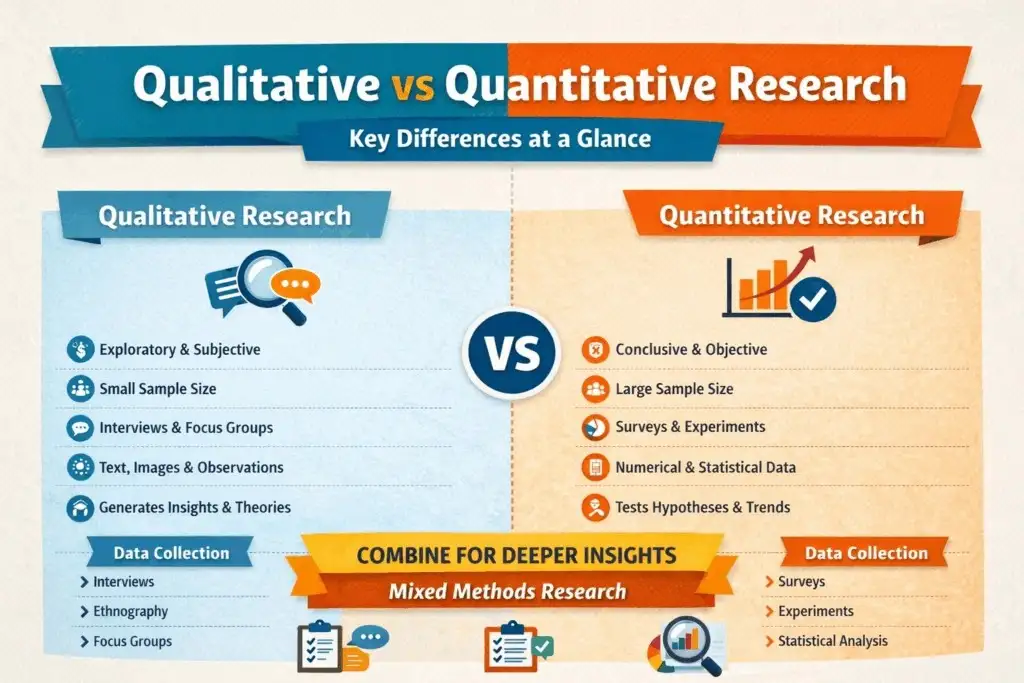
Qualitative research is a type of physical, empirical, exploratory, direct, and empathic research. It helps the researcher to understand the opinions, reasons, causes or trends that hide behind the data. The face to face interview method of data collection is the most commonly used method in qualitative research in which a small sample of respondents is interviewed for a long time, even for hours, often supported through qualitative data collection services and interpreted using qualitative data analysis services.
Quantitative Research and Questionnaire Development Services
Quantitative analysis lets the researcher to calculate, using empirical data or only data that can then be quickly converted into statistics, and it tests a wide sample of respondents’ behaviour, views and attitudes. The reason for collecting more sample is that if there is more data than the results will be more accurate (Denscombe, 2010). The Data collection methods takes various forms such as online surveys, telephonic surveys, etc., typically designed with the help of questionnaire development services. However, the most common method of data collection is that the telephonic research or web research and the time taken for this type of data collection will be approximately 10 minutes for each respondent.
| QUALITATIVE RESEARCH | QUANTITATIVE RESEARCH | |
| Concept | It is the characterisation of the believes about the phenomena | Exclusive attention is given in this type of research to the theory. |
| Approach | Naturalistic or Subjective | Experimental or Objective |
| Type of research | Exploratory research | Certain or conclusive research |
| Research theory | Inductive – here the researcher omits the theoretical background of the study | Deductive – here the research is based on justification of the proposed theory |
| Sampling | Purposive | Random |
| Data | Verbal | Measurable |
| Inquiry | Process-oriented | Result-oriented |
| Hypothesis | Generated | Tested |
| Elements of analysis | Words, pictures and objects | Numerical data |
| Objective | To explore and discover ideas used in the ongoing processes. | To examine cause and effect relationship between variables. |
| Methods | Non-structured techniques like In-depth interviews, group discussions etc. | Structured techniques such as surveys, questionnaires and observations. |
| Analysis type | Case based | Variable based |
| Result | Develops initial understanding | Recommends final course of action |
Understanding Research Objectives with Research Methodology Services
Different research methods are used in Qualitative and Quantitative research to collect and analyses data, and allows the researcher to answer various types of research questions. In order to write the valid research proposal, you should know the difference between the two types of research methods (Denzin & Lincoln, 1994). This list of difference allows the researcher to make the conclusion about which type of research they going to do and which method of data collection is suitable with guidance from research methodology services.
Role of Researcher, Sample Size and Qualitative Data Analysis Services
Furthermore, in the quantitative research, the researchers will not involve in the interview process and the data collected based on different modes are then analysed to draw a valid conclusion. However, in the qualitative case, the researcher is directly involved in the data collection process through qualitative data collection services. In qualitative research, only small sample size calculation is selected to understand the concept thoroughly, whereas in the quantitative study large samples are collected and generalize the results to the population. Quantitative research focus on testing theories or hypothesis whereas qualitative research formulates the theories or hypothesis (Glaser & Strauss, 1967). Quantitative data is analysed using advanced mathematical and statistical tools and techniques whereas qualitative data is often the type of summarization and interpreting from it using qualitative data analysis services. Quantitative study needs large samples whereas qualitative requires small samples and the questionnaire is of multiple choice in quantitative and open-ended type in qualitative, usually structured with questionnaire development services.
Data Collection Methods in Qualitative and Quantitative Research
Data can be collected for these two types of research in various ways and the main thing to keep in mind is that it should be helpful to answer the research questions (Glaser & Strauss, 1967). Mostly, data collection may be either qualitative or quantitative. For instance, in case studies, the data can be in number like frequencies or rating scale, and in surveys, the data can be in the form of text, etc.
Quantitative Data Collection and Questionnaire Development Services
Experiments: Experimental variables can be controlled and used to identify the cause-and-effect relationships.Surveys: Survey questionnaire involves a list of multiple choice questions and the data can be collected through online mode, in person, or over the phone with the support of questionnaire development services.Observations: In this case, the variables cannot be controlled and it is natural.
Qualitative Data Collection Services and Qualitative Data Analysis Services
Interviews: The data is collected orally by asking open-ended questions to targeted samples through qualitative data collection services.
Ethnography: Observing the cultural behaviour closely in a community for long period.
Focus groups: Gathering data from discussion among a group of people about a topic.
Literature review: Collecting the already published works and making a review, later interpreted using qualitative data analysis services.
Conclusion on Selecting Research Objectives with Research Methodology Services
In summary, an innovative and interesting research is the one which include both the methods in the research together. However, there are certain research areas which require only one type of research as in few medical examinations and the selection of research methods is purely depend upon the researcher. Qualitative research is interpretative research whereas quantitative research is the concrete one. On the whole, I would suggest a rule thumb for selecting the right research method is that, if the researcher wants to confirm or test a theory or hypothesis then quantitative research is the key, and if the researcher wants to understand any concepts, thoughts, etc., then the qualitative research is the best tool. Further, it is recommended to the researchers to decide upon which method of research is need for the study, deeply understand the differences, and choose appropriately with the help of research methodology services.
References
- Denscombe, M. (2010). The Good Research Guide: For Small-Scale Social Research Projects: for small-scale social research projects. McGraw-Hill Education. https://books.google.co.in/books?id=woS5P2Y6HFUC
- Denzin, N. K., & Lincoln, Y. S. (1994). Handbook of qualitative research. Sage Publications. https://books.google.co.in/books?id=u8hpAAAAMAAJ
- Glaser, B. G., & Strauss, A. L. (1967). The Discovery of Grounded Theory: Strategies for Qualitative Research. Aldine. https://books.google.co.in/books?id=_4BGvgEACAAJ
Contact us

Related posts