
- Services
- Data Analysis services
- Sample Work
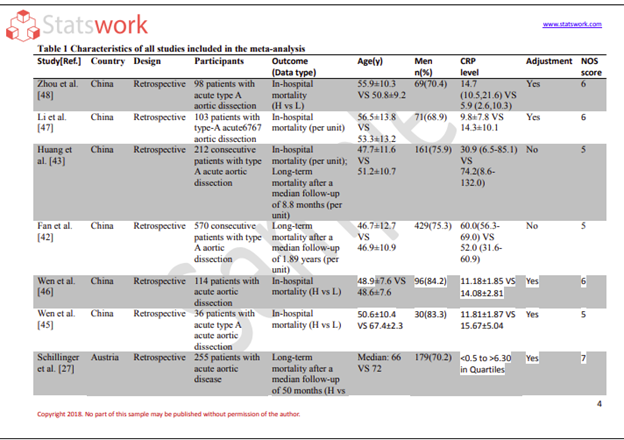
Data Analysis services
- Secondary Qualitative Research Services
- Secondary Quantitative Research Services
- Meta-Analysis Research services
- Sample Work
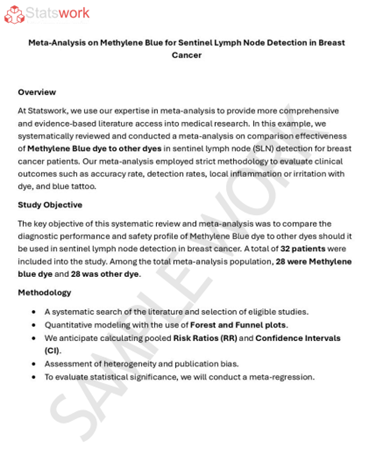
Meta-Analysis Research Services
- Data Collection Services
- Sample Work
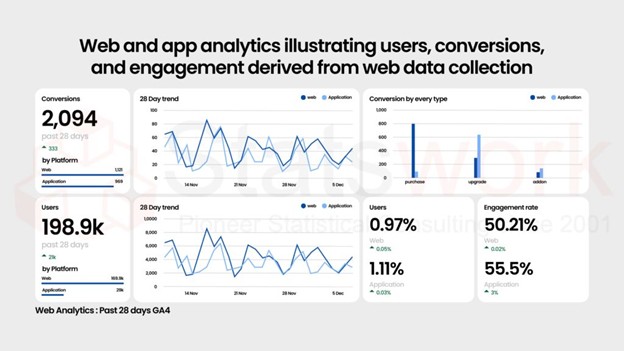
Data Collection Services
- Statistical & Biostatistics services
- Sample Work
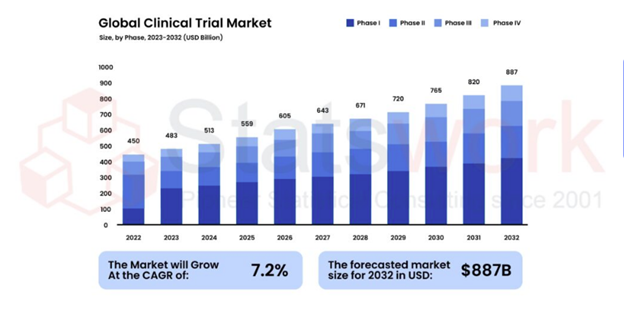
Statistical Programming & Biostatistics services
- Data Management Services
- Sample Work
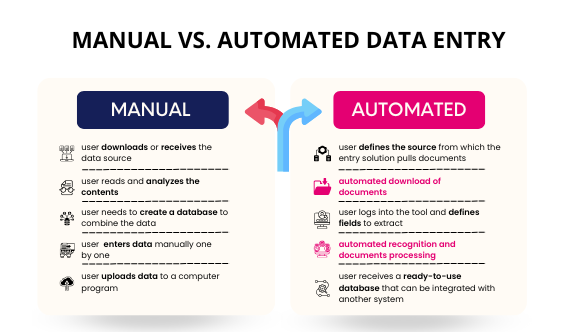
Data Management Services
- Research methodology services
- Sample Work
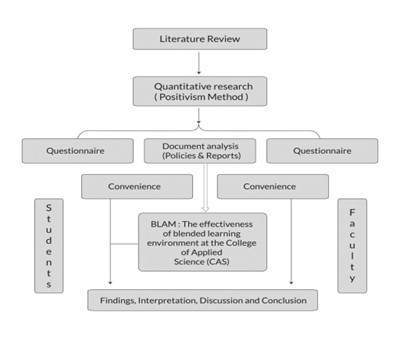
Research methodology services
- Tool Development Services
- Sample Work
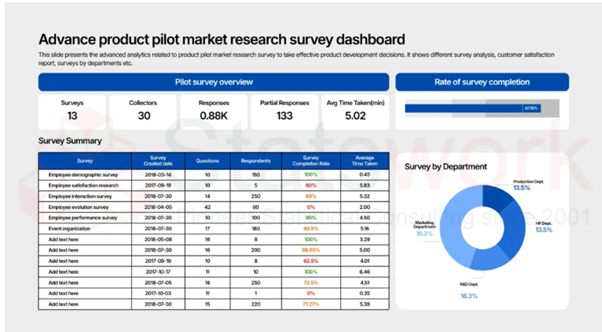
Tool development services
- Statistical Interpretation services
-
Statistical Interpretation services
- Sample Work
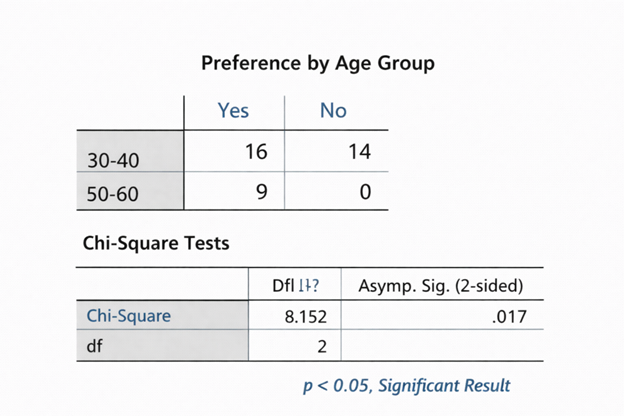
Statistical Interpretation services
-
- Sample Size Calculation Services
-
Sample Size Calculation Services
- Sample Work
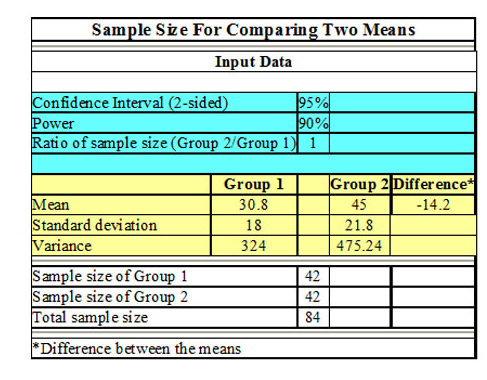
Sample Size Calculation Services
-
- AI & ML Services
-
Artificial Intelligence and Machine Learning Services
- Sample Work
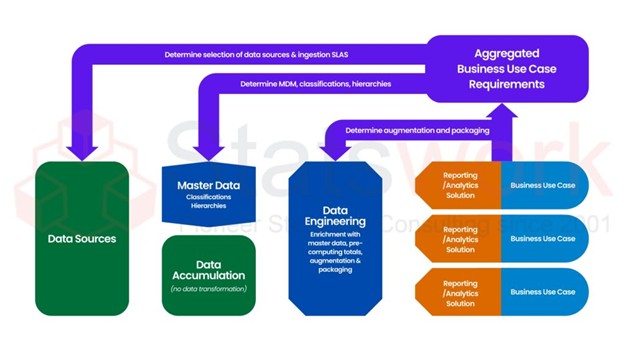
Artificial Intelligence and Machine Learning Services
-
- Meaningful Visualization Services
- Thought Leadership Services
- Report Generation Services
-
Report generation Service
- Sample Work
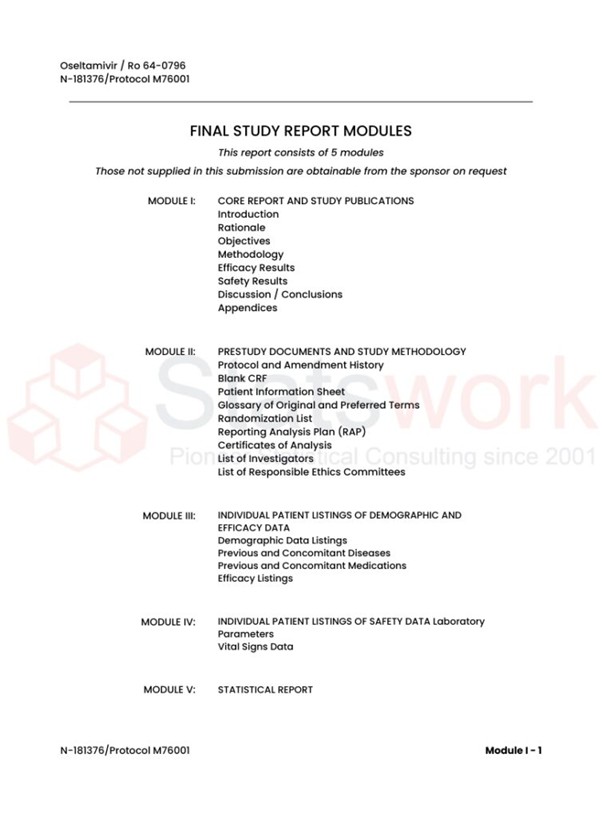
Report generation Services
-
- Data Analysis services
- Industries
- About Us
- Blog
- Insights
- Contact Us
- Services
- Data Analysis services
- Sample Work
Data Analysis services
- Secondary Qualitative Research Services
- Secondary Quantitative Research Services
- Meta-Analysis Research services
- Sample Work
Meta-Analysis Research Services
- Data Collection Services
- Sample Work
Data Collection Services
- Statistical & Biostatistics services
- Sample Work
Statistical Programming & Biostatistics services
- Data Management Services
- Sample Work
Data Management Services
- Research methodology services
- Sample Work
Research methodology services
- Tool Development Services
- Sample Work
Tool development services
- Statistical Interpretation services
-
Statistical Interpretation services
- Sample Work
Statistical Interpretation services
-
- Sample Size Calculation Services
-
Sample Size Calculation Services
- Sample Work
Sample Size Calculation Services
-
- AI & ML Services
-
Artificial Intelligence and Machine Learning Services
- Sample Work
Artificial Intelligence and Machine Learning Services
-
- Meaningful Visualization Services
- Thought Leadership Services
- Report Generation Services
-
Report generation Service
- Sample Work
Report generation Services
-
- Data Analysis services
- Industries
- About Us
- Blog
- Insights
- Contact Us
Choosing Between One-Way and Two-Way ANOVA for Effective Research Analysis
Qualitative Research Service
News & Trends
Recommended Reads
Contact us
Summary:
Proper selection of ANOVA technique is vital for valid quantitative analysis. One-way ANOVA test compares three or more groups on the basis of one independent variable whereas two-way ANOVA tests the effect of two independent variables and their interaction. This blog gives details about the difference between both techniques of ANOVA, assumptions of ANOVA, post hoc test and which test to apply depending on research design and sample size. The blog also emphasizes on situations where ANOVA should be preferred over multiple t-tests.
Quick Answer
One-way ANOVA is commonly used to compare means across three or more groups defined by one factor. Two way ANOVA is conducted to check the influence of two independent variables simultaneously, along with their interaction effect. One should apply one way ANOVA when there is only one factor in his/her study (for example “method of teaching”).
What Is One-Way ANOVA?
One-way ANOVA compares the means of three or more independent groups. Its omnibus F-test evaluates whether all group means are equal or whether at least one differs, under the model assumptions. [1].
Common examples:
- Comparing exam scores across three teaching methods
- Comparing plant growth across four fertilizer types
- Comparing customer satisfaction across five store locations
What Is Two-Way ANOVA?
Two-way ANOVA extends the same logic to two independent variables simultaneously. It reports three results instead of one:
| Effect Type | What It Says |
|---|---|
| Factor A main effect | Whether Factor A has a significant main effect. If an interaction is present, interpret the interaction first. |
| Factor B main effect | Whether Factor B affects the outcome by itself |
| Interaction (A × B) effect | Whether the effect of one factor depends on the other factor |
What is so important about the interaction effect in two-way ANOVA? In the following example, a training program may have helped juniors perform better while not having any effect on the seniors at all [2].
One-Way vs Two-Way ANOVA: Side-by-Side Comparison
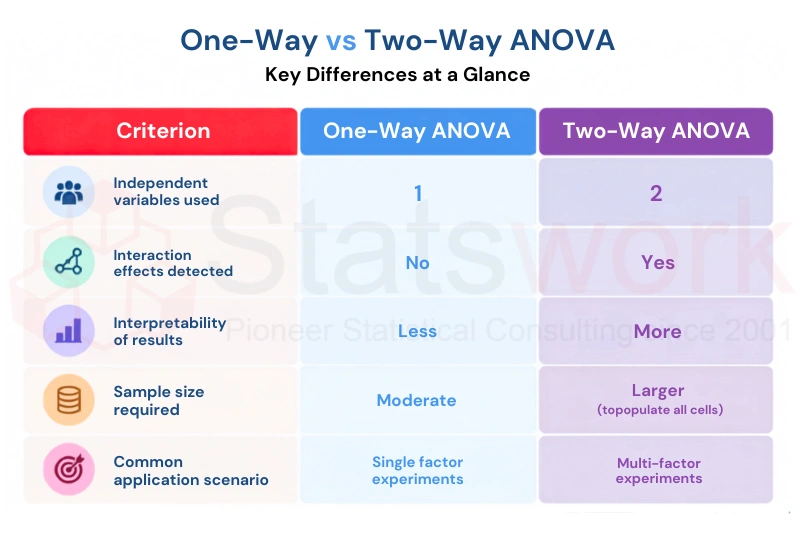
ANOVA vs T-Test: A Quick Clarification
A t-test is generally used to compare the means of two groups, while ANOVA provides a general linear-model framework for comparing means across multiple factor levels. When more than two groups are compared, ANOVA can assess whether there is evidence of differences among the group means while controlling the overall Type I error rate more effectively than conducting multiple pairwise t-tests..
Assumptions for ANOVA
- Before conducting ANOVA, assess key assumptions such as independence of observations, approximate normality of model residuals, and homogeneity of variance. The degree to which assumption violations affect the results depends on factors such as sample size, design balance, and the nature of the violation. When assumptions are not adequately met, appropriate options may include robust methods, data transformations, or alternative statistical approaches suited to the research design. Normality assumption – The model residuals or errors should be approximately normally distributed. This assumption can be assessed using methods such as Q-Q plots, while formal tests such as the Shapiro–Wilk test may also be considered alongside graphical and contextual assessment.Variance homogeneity assumption – the variances in all groups are similar (use Levene’s test)
- Independence of observations
- The dependent variable must be continuous
What Happens After a Significant Result?
However, a significant ANOVA result indicates that at least one group mean differs from another, but it does not identify which specific groups differ. Further analysis using appropriate post-hoc multiple-comparison procedures, such as Tukey’s HSD or Bonferroni-adjusted pairwise comparisons, can help identify the specific group differences while accounting for multiple comparisons.[3].
How to Choose: A Basic Guide
- Consider the number and structure of the factors in the research design. If the study examines one factor, a one-way ANOVA may be appropriate. If it examines two factors and their potential interaction, a two-way factorial ANOVA may be suitable. Studies involving three or more factors may require a higher-order factorial ANOVA or a general linear model, depending on the research objectives, data structure, and assumptions.Can the variables interact with each other? It is important to perform two-way ANOVA if the researcher thinks two variables interact with each other.
- Sample size should be considered too. The two-way design must contain enough samples in all levels of factors.
Are the assumptions satisfied? Check assumptions such as independence, distributional characteristics, and homogeneity of variance before conducting ANOVA. If assumptions are not adequately met, appropriate options may include data transformations, robust ANOVA methods, or alternative factorial models suited to the research design. For a one-factor independent-groups design, the Kruskal–Wallis test may be considered as a non-parametric alternative when appropriate.
Final Takeaway
Whether a one-way or two-way ANOVA is appropriate depends on the research design, including the number and structure of the factors being studied and whether their interaction is of interest. The validity of the analysis also depends on factors such as independence of observations, measurement and data characteristics, model specification, underlying assumptions, and appropriate interpretation of the results.Looking for help in choosing and analyzing ANOVA in your dissertation, thesis, or corporate data? Get full assistance with ANOVA analysis from our statistical experts at StatsWork.
Frequently Asked Questions (FAQs)
Yes, and it’s usually preferable — it tests both main effects together and reveals interaction effects that separate one-way tests cannot detect.
No, but balanced designs (equal group sizes) simplify interpretation and increase statistical power.
Yes. Analysts frequently use one-way ANOVA to compare consumer response across a single variable (e.g., pricing tier) and two-way ANOVA when testing two variables together (e.g., pricing tier and region).
Use one-way ANOVA when your study examines the effect of one independent variable on a continuous outcome. Use two-way ANOVA when you need to evaluate two independent variables and their interaction.
Yes. Two-way ANOVA can determine whether the effect of one independent variable changes depending on the level of another variable. This interaction effect is a key advantage over one-way ANOVA.
A significant ANOVA indicates that at least one group mean differs, but it does not identify which groups are different. A post-hoc test such as Tukey’s HSD or Bonferroni can be used for pairwise comparisons.
Reference
- Njeri Mugwe, J., & Runo, S. (2026). Quantitative data analysis II (inferential analysis). In Research methodology in agricultural sciences(pp. 499-526). Singapore: Springer Nature Singapore.https://link.springer.com/chapter/10.1007/978-981-95-1892-0_21
- Rayarao, S. R. (2025). ANOVA models: a comprehensive review of analysis of variance in statistical analysis and experimental design.https://www.authorea.com/doi/full/10.22541/au.175192372.29532537/v1
- Sokra, I. (2025). Presenting Results from Two-Way ANOVA Experiments: Principles and Best Practices. Journal of Agriculture and Technology, 1(2), 123-138.https://www.researchgate.net/profile/In-Sokra/publication/399910306_Presenting_Results_from_Two-Way_ANOVA_Experiments_Principles_and_Best_Practices/links/696f45faee048155cffdf13c/Presenting-Results-from-Two-Way-ANOVA-Experiments-Principles-and-Best-Practices.pdf