

Statistical analysis using the Fuzzy approach
August 11, 2021
AI in Clinical Decision Support for Early Disease Detection
April 29, 2025Significance of Quantitative Techniques in the Decision-Making Process
Qualitative Research Service
- What Are Quantitative Techniques for Business Decision Making?
- Importance of Quantitative Techniques in Management
- Data-Driven Decision Making for Enterprises
- Types of Quantitative Techniques in Decision Making
- Business Analytics Decision Support Tools
- Predictive Analytics for Business Leaders
- Enterprise Applications of Quantitative Risk Analysis
- Market Research Quantitative Methods Corporate Applications
- Quantitative Modeling for Executives
- Conclusion
Recommended Reads
Contact us
Summary:
This post explains how important it is to use quantitative techniques in making business decisions. The post discusses how companies use statistics and other quantitative techniques like forecasting, predictive analytics, and risk analysis to make data-based decisions. Some of the decision-making techniques used by businesses include business analytics, which involves the use of analytical techniques to solve problems related to business. This post also shows how Statswork helps businesses in using their data to make decisions.
What Are Quantitative Techniques for Business Decision Making?
Methods of quantitative decision making include approaches which entail using mathematics, statistics, and analysis to analyze the issues and arrive at the best decision. With an increasing number of businesses operating within competitive environments, companies have started using data-based decision making to enhance efficiency, reduce uncertainties, and accomplish strategic objectives [1].
Such methods assist managers in turning raw information into knowledge that can help them take decisions based on evidence. In this way, quantitative methods play an important role in the management of businesses.
Importance of Quantitative Techniques in Management
Quantitative methods have gained a lot of significance in management because of the availability of more data in businesses coupled with the development of analytical tools. Organizational managers who make use of quantitative analysis gain an edge over their competitors and perform well [2].
Benefits of Quantitative Techniques
|
Benefit |
Business Impact |
|
Improved decision-making accuracy |
Supports objective decision-making based on facts |
|
Risk management |
Aids in risk identification and management |
|
Efficient resource management |
Assists in optimal use of available resources |
|
Forecasting |
Forecast future developments in business |
|
Efficiency |
Make operations more efficient |
|
Strategic planning |
Achieving organizational goals |
By applying quantitative methods, managers can reduce uncertainty and make decisions that align with organizational objectives.
Data-Driven Decision Making for Enterprises
Enterprise Data-Driven Decision Making
This refers to decisions that an organization makes based on its analytical understanding. Enterprises make huge amounts of data during their daily operations, especially when dealing with customers, conducting sales, processing financial transactions, and through internal operations [3].
Benefits of data-driven decision making include:
- Improved forecast precision
- Faster reaction to market dynamics
- Enhanced understanding of customers
- Business performance optimization
- Strategic planning efficiency
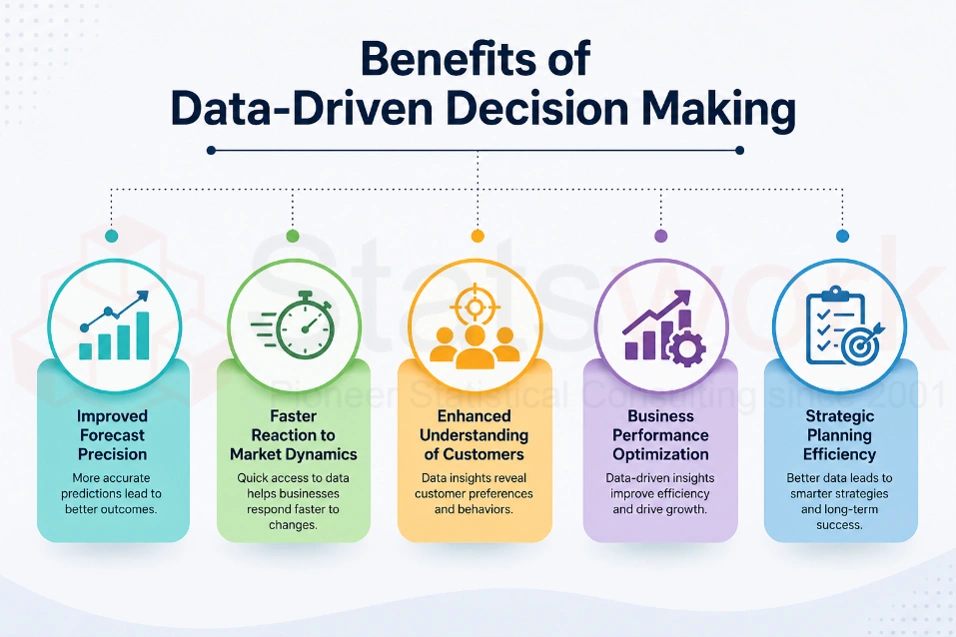
Data-driven organizations will be able to use their competitive advantage and adapt to new market conditions.
Types of Quantitative Techniques in Decision Making
Organizations use various types of quantitative techniques in decision making depending on the nature of the business problem and available data.
|
Quantitative Technique |
Purpose |
Business Application |
|
Statistical Analysis |
Identify trends and relationships |
Customer analytics, performance evaluation |
|
Forecasting Models |
Predict future outcomes |
Sales forecasting, demand planning |
|
Optimization Models |
Determine the best solution |
Resource allocation, logistics planning |
|
Simulation Analysis |
Evaluate alternative scenarios |
Risk management, operations planning |
|
Decision Trees |
Compare alternatives and outcomes |
Strategic decision-making |
These techniques provide a structured framework for evaluating business situations and selecting optimal solutions [4].
Business Analytics Decision Support Tools
Decision support tools in business analytics provide companies with assistance for data collection, processing, and analysis to enhance the quality of decisions made. These decision support tools integrate the use of statistics, reporting, and predictive modeling.
Common Business Analytics Decision Support Tools
|
Type of Tool |
Main Purpose |
Example Scenario |
|
Business Intelligence Solutions |
Analysis of organizational data |
Reporting to executives |
|
Data Visualization Solutions |
Visualization of data insights |
Creation of dashboards |
|
Statistics Packages |
Analytics |
Market research |
|
Predictive Analytics Solutions |
Forecasting |
Forecasting customer behavior |
These tools enable organizations to make faster and more informed decisions based on real-time information [5].
Predictive Analytics for Business Leaders
Predictive analytics in business for leaders is now a vital part of strategic planning. Through predictive analytics, businesses will be able to predict future events by evaluating existing and past data.
The reasons why business leaders need predictive analytics include:
- Forecasting sales and earnings
- Forecasting customers’ actions
- Discovering business prospects
- Inventory control optimization
- Business risk reduction
Proper anticipation of future events enables effective allocation of organizational resources.
Enterprise Applications of Quantitative Risk Analysis
Risk assessment is an integral element of any successful organization. The quantitative risk analysis enterprise approach enables organizations to evaluate uncertainties in their decision-making process.
Applications of Quantitative Risk Analysis
|
Area of Risk |
Application |
|
Financial risk |
Portfolio management and budgeting |
|
Operational risk |
Process management |
|
Market risk |
Sales prediction and competitor analysis |
|
Project risk |
Project planning |
|
Compliance risk |
Policy analysis |
By understanding risk probabilities and potential impacts, organizations can develop strategies that improve resilience and long-term sustainability.
Market Research Quantitative Methods Corporate Applications
Quantitative methods employed by teams of corporations for market research are critical in determining consumer preferences and market trends.
Some of the quantitative methods used in market research include collecting numerical data such as customer feedback, questionnaires, survey results, and transactional data. Firms conduct quantitative market research to:
- Monitor customer satisfaction
- Conduct brand awareness analysis
- Analyze the efficacy of advertisements
- Determine target audience characteristics
- Assess product demand [4]
Quantitative market research helps firms to devise better marketing strategies and engage effectively with consumers.
Quantitative Modeling for Executives
Quantitative modeling for executives offers a systematic framework that allows executives to evaluate their options in specific business situations. Quantitative models are based on the use of mathematics and statistical techniques.
Executives conduct quantitative modeling to:
- Evaluate investment options
- Conduct financial planning
- Optimize operations
- Analyze business alternatives
- Conduct forecasts
Key Takeaways
- Quantitative methods aid evidence-based business decision making.
- Enterprise decision making based on data is more efficient and competitive.
- Business analytics decision support systems offer valuable insight to managers and executives.
- Predictive analytics aids organizations in forecasting future possibilities.
- Quantitative risk assessment enhances risk management and strategic planning.
- Market research quantitatively can provide insights into customer behavior and market situation.
- Quantitative modeling assists executives in assessing alternatives.
Conclusion
These days, quantitative techniques have become essential to those firms wishing to ensure that their decision-making is as effective as possible and can enable sustainable growth for the organization concerned [5]. From predictive analytics for use by business executives through to quantitative risk analysis enterprise applications, all of these techniques help provide the foundation required for effective decision-making.
With firms continuing to take advantage of digital transformation, it is becoming increasingly necessary to make use of quantitative techniques for management processes. Those firms that take advantage of such business analytics decision support systems and quantitative methods corporate market research teams employ, among others, can enjoy significant advantages going forward.
The range of services we offer at Statswork includes statistical analysis, business analytics services, predictive analytics, forecasting models, regression analysis, quantitative risk analysis, market research, surveys and data analysis.
Frequently Asked Questions:
Quantitative significance refers to the statistical importance of numerical findings, indicating whether observed differences or relationships in data are meaningful and unlikely to have occurred by chance.
Quantitative research is significant because it provides objective, measurable, and data-driven insights that help researchers and organizations make informed decisions and draw reliable conclusions.
Quantitative techniques in geographical studies help analyze spatial data, identify patterns, measure relationships, and support evidence-based decision-making in areas such as urban planning, environmental management, and resource allocation.
The four common types of quantitative methods are descriptive research, correlational research, causal-comparative research, and experimental research, each used to analyze numerical data and test relationships between variables.
The level of significance is the probability threshold used to determine whether a statistical result is significant, commonly set at 0.05, indicating a 5% chance that the observed result occurred randomly.
Reference:
- Lim, J. Y., Killgore, W. D., Bennett, D., & Drummond, S. P. (2025). The impact of sleep loss on decision making: opening the cognitive black box. Sleep Medicine Reviews, 82, 102114. https://www.sciencedirect.com/science/article/pii/S108707922500067X
- Cerchione, R., Morelli, M., Passaro, R., & Quinto, I. (2025). A critical analysis of the integration of life cycle methods and quantitative methods for sustainability assessment. Corporate Social Responsibility and Environmental Management, 32(2), 1508-1544. https://onlinelibrary.wiley.com/doi/abs/10.1002/csr.3010
- Wei, Y., Ji, L., & An, D. (2025). Review on quantitative methods of fish school behaviors. Reviews in Aquaculture, 17(3), e70023. https://onlinelibrary.wiley.com/doi/abs/10.1111/raq.70023
- Madanchian, M., & Taherdoost, H. (2025). Applications of multi-criteria decision making in information systems for strategic and operational decisions. Computers, 14(6), 208. https://www.mdpi.com/2073-431X/14/6/208
- Lagzi, M. D., Farkhondeh, F., Amoozad Mahdiraji, H., & Sakka, G. (2026). Exploring data-driven decision-making practices: a comprehensive review with bibliometric insights and future directions. EuroMed Journal of Business, 21(2), 728-762. https://www.emerald.com/emjb/article-abstract/21/2/728/1251377/Exploring-data-driven-decision-making-practices-a?redirectedFrom=fulltext
Contact us

Related posts